
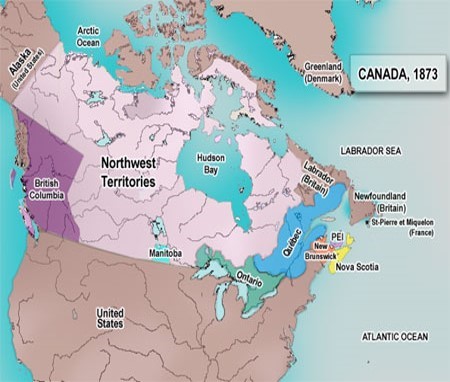
The map shows North America in 1873. The Canadian provinces of Ontario, Quebec, Prince Edward Island, New Brunswick, New Scotland and Newfoundland are in the eastern part of Canada, Manitoba is the first province on the plains, while west on the Pacific Ocean is British Columbia. Alaska in the northwest corner of the continent and the United States in the south. Greenland is east.
Nova Scotia or New Scotland is one of Canada’s oldest provinces and participated in the creation of a new nation-state in 1867. The community in the state has a long history that can be traced back to the 16th century when fishermen from Europe began to work fish inland. French settlers founded the first colony and befriended the indigenous people, the Micmaq people who had lived there for centuries. Later, British influence became strong and gradually the British Empire gained power. The main occupations were fishing and logging, the province did not offer a favorable climate or fertile soil, which was suitable for extensive and varied agriculture. Early in the history of the young nation-state of Canada, the government began to consider immigration. The path of thousands of immigrants to America from Europe was through St. Lawrence Bay to Quebec and from there to Toronto, Ontario. Most of them then disappeared south to the United States to Michigan and Wisconsin, but in the middle of the 19th century, settlement in the United States grew rapidly in the west. The expansion of the United States was of some concern to the Canadian government, because it was clear that the United States’ dominion extended from the Atlantic Ocean west to the Pacific Ocean. The United States had bought Alaska in the northwest from the Russians, so people wondered how far north the United States intended to go. Soon after the United States was created in the 18th century, the British exited from there with their troops north to British North America and border disputes flared up. It was to Canada’s credit that in 1871 British Columbia on the Pacific Ocean became one of the provinces of the nation, as this strengthened Canada’s position in the border dispute. The colonial government in British Columbia saw several advantages in uniting with Canada. The province did not break ties with the British Empire and all contact with Great Britain was better secured through Canada than the United States, and then Canada agreed to the construction of a railway from Toronto west to the Pacific Ocean.
Icelanders: In the fall of 1874, a large group went west to Ontario, Canada, and Sigtryggur Jónasson had prepared their arrival. The group went to Kinmount and Jóhannes Arngrímsson, the agent of the provincial government in Nova Scotia, arrived there. Sigurður J. Jóhannesson described his arrival there as well as his settlement in NS in an article in the Almanak in 1900: “Soon after the arrival of this group (the group from Iceland Ins. JÞ), a young man, Jóhannes Arngrímsson (priest from Bægisá in Eyjafjörður), arrived there from New Scotland (Nova Scotia) in the east. He said that he was the emissary of the government there, and that he had full authority to invite men there to take land on the most splendid terms, and he described the fertility of the soil and other things there. And because he was a nimble man and always followed through on this matter (lipur maður og fylgdi máli þessu allfast fram), he became quite aggressive. It soon sparked considerable division and dissatisfaction among many, who also did not begin to see the future prospects there in Kinmount as good…. Jóhannes went back in the autumn to Halifax, the capital of New Scotland, and with him several young, free men who stayed there over the winter. Quite a few families also signed up with him and decided to travel the following spring and the following fall; and there would have been around or over 80 people. Then a little more people came from home, so the number of people reached 200, or even more, when the population was highest, both in the colony (Markland Ins. JÞ) and a small town called Lockport. Those who settled in that town had jobs in canneries, fishing and rowing.”
Markland: Immigration issues were high on the agenda of the Canadian authorities from the beginning (1867), not least after British Columbia became a province of the nation. The Canadian plains from Ontario west to the Rockies awaited farmers, vast and fertile. The provinces of Eastern Canada were similarly eager for labor, industry was making great progress in Ontario, agriculture in Quebec, and fishing and logging in the Atlantic provinces. How Jóhannes Arngrímsson became an agent of the provincial government of Nova Scotia was never explained, he went west to Milwaukee, Wisconsin in 1872 and has probably been in contact with people like Sigtryggur Jónasson in Ontario, who became an agent of the government there. The great debate both in the West and at home in Iceland about forming an Icelandic colony in the West certainly did not pass by Jóhannes, and it seems that he agreed with Sigtryggur Jónasson that it should be formed in Canada. Perhaps the explanation for his agreements with the Nova Scotia government is that Sigtryggur wanted the colony in Ontario, so in 1874 there was hardly any other place in Canada, and the location on the Atlantic Ocean had some influence. Vigfús Sigurðsson from Granastaðir in S. Þingeyjarsýsla was in Parry Sound, Ontario in the years 1874-1875. He was in regular contact with his countrymen in the United States and Canada and was able to send news to Iceland. In one letter dated from Parry Sound on January 25, 1875, he describes the offer of the Nova Scotia government and says: “Recently it has been received by us in the letters of the countrymen in Kinmount, that some of them there were thinking of going to Nova Scotia (New Scotland), because Jóhannes Arngrímsson, who is said to have become the agent of the government there, has brought them a great offer, e.g. everyone who is over 15 years of age will be given land, 100 acres, of which two are cleared and burned together with a house and a new settlers’ grant of 11 dollars, etc.” Vigfús cannot say who sent him this news, but what he writes is some information sent to Iceland inaccurate. ÞÞÞ says in the 2nd issue of SÍV p. 301: Vigfús cannot tell who sent him this news, but the information he writes and sends to Iceland is somewhat inaccurate. ÞÞÞ says in the 2nd issue of SÍV p. 301: “No one remembers the grant except Vigfús, who also reported to Parry Sound that the cleared acres were two instead of one.” Then Eiríkur Hansson (Jóhann Magnús Bjarnason’s autobiography) says that each head of the family also received: “a stove (heating machine) and other necessary household utensils, together with enough food for the whole family, for one year, or the next; and all this without any consideration, because even though it should be called a loan at first, there was never any payment for it” (Eiríkur Hanson pg. 49).
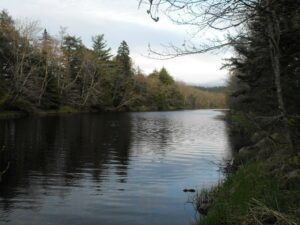
Elgsheiðar: Jóhann Magnús Bjarnason has Eirík Hanson describe the settlement area: “The Icelandic settlement in New Scotland was on several ridges, about 50 English miles from the city of Halifax. These ridges were overgrown with rugged forest, which was a very difficult task for the pioneers. The soil there is barren and excessively rocky. Here and there are heather bogs, overgrown with moss. There are rivers and streams and ponds everywhere, and the water is silvery and cool. The climate is healthy and the sea breeze refreshing. It is never very cold in the winter, nor very hot in the summer. From the colony south-east to the sea, there are 12 English miles. The beach there is very indented and it can be said that a village is in the balance of each cove. On the west side of the ridges, there is a large and beautiful valley, called Musquodoboit, an old and flourishing village…When you come out of the woods and onto the edge of the ridge, this wondrous region faces the sea… Out of the valley flows the Musquodoboit river, calm and with countless beautiful bends out to the sea.” The description of the valley is beautiful, but the author has few words about the shortcomings of the settlement. The forest on Elgsheiður was dense and the settlers worked tirelessly to clear the land, cutting down forest, pulling up roots and trying to plough. Tree trunks that were not used as building materials were piled together in huge piles and burned. There was no way for the settlers to get the material down to the sawmills by the sea. Jóhannes Arngrímsson’s descriptions were based on the reviews of locals who also did not seem to have familiarized themselves with the area in question. Aboriginal people and French settlers, as well as later British ones, had not looked at this area in the last decades and that perhaps tells its story, no one had tried farming so why would the area be suitable for Icelandic settlers? The descriptions of the settlement area were also accompanied by many stories of the abundance of game animals and freshwater fish, but when you got to the islet, the game animals were all gone and trout could not get up to the rivers and lakes because dams had been built further down in the main rivers. The Icelanders had hardly been in the area for more than a year when it became clear that the area did not live up to expectations, and therefore the provincial government decided to withdraw the golden invitation to Icelanders who wanted to go there in the coming years. This even went so far that agents of the government boarded a westbound ship and met Icelanders who were going to Markland. They told everyone not to go to Markland.
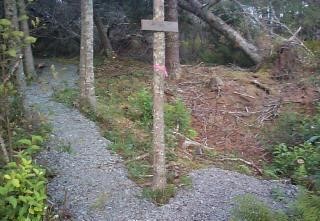
The Icelandic Society of Nova Scotia has mapped the settlement and laid gravel in many places. On this picture was Vatnsdalur, Brynjólf Brynjólfsson’s farm. The longer path leads to a latrine that stands behind the town. Photo: Icelandic Society of Nova Scotia.
Persevere or perish: When it became clear to the settlers and agents that the land on Elgsheiður would never be cleared and that there would be little profitable agriculture, the provincial government tried its best to make life in the settlement bearable. It had a road built through the colony in the first years of settlement and the Icelanders got to work on the road construction. In the spring of 1876, the provincial government provided the settlers with seed and that people sowed in the small spots they had managed to clear. The settlers continued logging, working in groups of three or four, as the work went better this way. Farmers didn’t have oxen or horses in those early settlement years, and when it was clear that a crop would be harvested, the only solution was to haul oats and wheat almost 30 km to the nearest mill. Besides that, the provincial government did well because in the spring of 1876 a schoolhouse was built in the middle of the settlement and the government hired a British teacher to take care of the teaching. This was the first time in the history of Icelandic settlement that the authorities built a school and started teaching in a young Icelandic settlement in the West. Guðbrandur Erlendsson, a settler in Markland, wrote his memoirs and there he says about the school building and gatherings there: “The administration did not wait long for a school building. They had it built in the middle of the settlement and hired an English teacher for it. We were not taxed so much as one dollar during the years we were in New Scotland. Is it one of the many things that shows that the administration was interested, that we could feel good. – … As soon as the schoolhouse was completed, the settlers had a meeting there. The first topic of discussion was what the colony should be called, and it was called Markland. It seemed appropriate to adopt the name that Leifur Eiríksson gave to New Scotland when he discovered America. It was then decided to gather in the schoolhouse for church services on Sundays, as often as circumstances allowed. Everyone agreed. – Brynjólfur Brynjólfsson was the life and soul of that Christian activity, like everything else, which is subject to progress. Thanks and honor to him for that and much more. These pious gatherings were well attended, even though everyone had to walk, and it was remarkable how much work was done on the weekdays, because it was certain that no one was lying on their side but cooperating with each other to get the most work done.” An Icelandic priest never came to Markland, but the German settlers in Lunenburg, a small town by the Atlantic Ocean, responded well and sent priests to the settlement. They baptized children and confirmed and married couples, but Brynjólfur Brynjólfsson buried the dead. There in Elgsheiður, people persevered, some for nearly seven years. Good news from Icelandic settlements west of the Canadian plains, in N. Dakota and Minnesota reached east to Markland and people began to think about moving on. When it was clear that people wanted to leave, land ownership was negotiated with the provincial government. The government stop them, everyone got a full title deed for their land and some managed to sell it for a small price, but what was left of the scrap was enough for the family to move away to more prosperous Icelandic settlements.